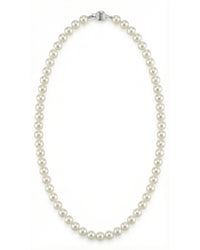
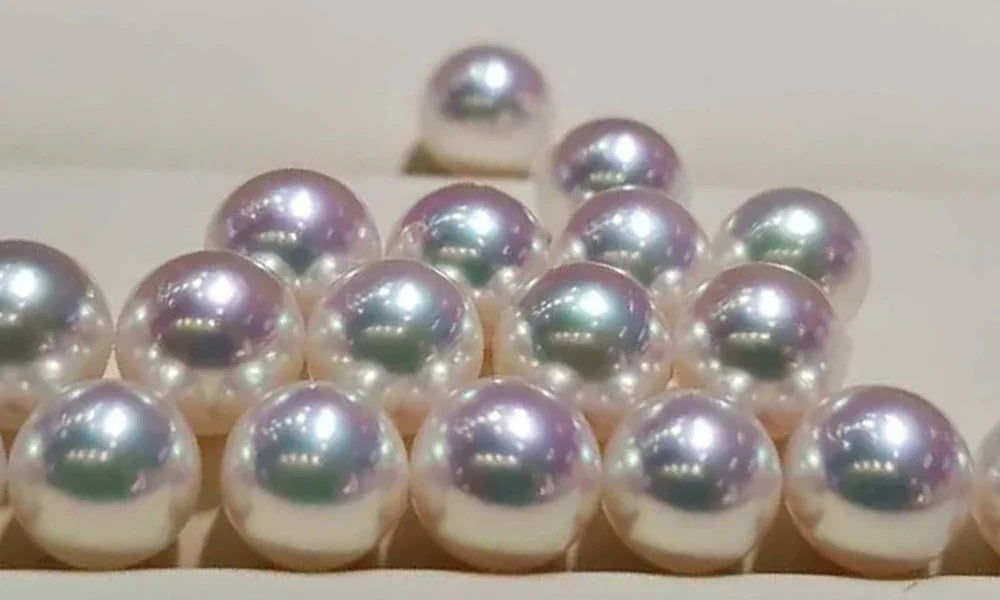
I'm writing today to talk about "The Aurora Effect." Often referred to as "orient," this iridescent effect is visible on the surface of very fine grade pearls.
The PSL (Pearl Science Laboratory of Japan) describes it as such:
Aurora Effect is the characteristic phenomena of iridescent color that may appear on the surface of a pearl.
They test for this by using a cleverly named "Aurora Viewer", which shines a particular light on the underside of the pearl to reveal if there is visible Aurora.
Below are pictures of a Madama Akoya strand showing fantastic "aurora". Top Range white Hanadama will show this effect as well, but it's extremely difficult to photograph.


Not to be confused with an overtone, the aurora is not actually a coloration of the pearl.
This mesmerizing rainbow of colors is caused when white light enters the pearl, and through refraction, is separated into its spectral colors. Similar to how light enters a diamond or prism and reflects back many different colors.
For this to happen, the pearl needs to have very fine nacre quality with a tight crystalline structure. Most pearls do not have sufficient nacre quality to display aurora or orient.
Below is a certificate I pulled from an online seller. Note that the strand was NOT tested for Aurora and has no description of iridescence.
I'd suggest avoiding certs like this, it's worth less than one that was tested for Aurora.
Click Here to View Larger Image
Instead, look for the following remarks:

Click Here to View Larger Image
And under "Teri Analysis" you want to see described iridescent color:

Click Here to View Larger Image
I hope you found this information useful. If you're interested in owning a Hanadama or Madama with strong aurora, visit our collection of Hanadama Akoya Pearls.