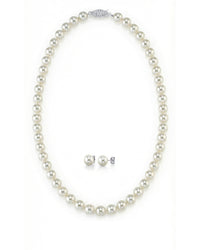
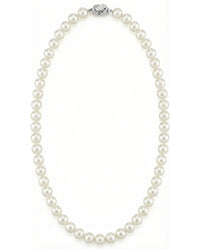
Freshwater vs Akoya Comparison Guide
Shape: Freshwater pearls feature a variety of shapes, ranging from nearly perfectly round AAAA Grade pearls to slightly off-round, ovals, potato shapes, drops and funky free-form baroques. Saltwater Akoya pearls are usually perfectly round in all pearl grades.
Luster: Freshwater pearls generally feature a softer, more “satiny” luster that tends to be visibly more diffuse around the edges of reflected light sources. Akoya pearls display very sharp and bright luster, even in some of the lower qualities.
Sizes: Freshwater and Akoya pearls both have a comparable size range, but Freshwater pearls can get even larger than the Akoya by a few sizes. Both pearl types start at 2.0 – 3.0 mm and range up to 9.5 and 10.0 mm, but that’s where the Akoya pearls top out. Freshwater pearls keep going, and traditionally nucleated pearls reach sizes of 11.0 – 12.0 mm, and newer bead nucleated varieties can get up to 15.0 – 16.0 mm – very similar to the size range of South Sea pearls.
Colors: Freshwater and Akoya pearls are both available in traditional white body colors with classic overtones of rose, silver and cream.
Blemishes:Freshwater pearl blemishes are usually white “chalky” spots, subtle ridges, tiny pin pricks and small, streak-like score marks. Akoya pearl blemishes also include subtle white “chalky” spots and tiny pin prick-like inclusions, but also include flat spots, wrinkling in the nacre. Keep in mind that both the Akoya and Freshwater pearl’s inclusions are pretty small, and should only be visible upon careful inspection.
Prices: Freshwater pearls are generally less expensive than Akoya pearls, by a factor of 20-50%, depending on the pearl quality and size. Akoya pearls are generally considered to be a luxury pearl type, and yearly harvest amounts are dwarfed in comparison to Freshwater pearls, so are generally more expensive.